Thursday, February 23, 2012

            Things are well in my artistic world. I feel that school has been a very nurturing place and I have grown as an artist since last September. These last two semesters, I have learned so much about form and the human figure. I am finally starting to bridge the giant gap that exists between my 2 and 3 dimensional world. 
            My sculpture/pottery teacher is a freaking genius.  He had the class start with three, 7 inch torsos, moving on to a seated 1/7th posed figure, then to a 17 inch, half-size torso.  Looking at these torsos, I see how useful doing the smaller sculptures first was.  I especially see the progress I have made in rendering the shoulder area. In the first photo, the smaller one,  her shoulders are too broad. They look as if they belong on an entirely different figure, some kind of body builder chick.


            By the time I got to sculpting the bigger one, I was able to realize and learn from my mistakes to not repeat them again.


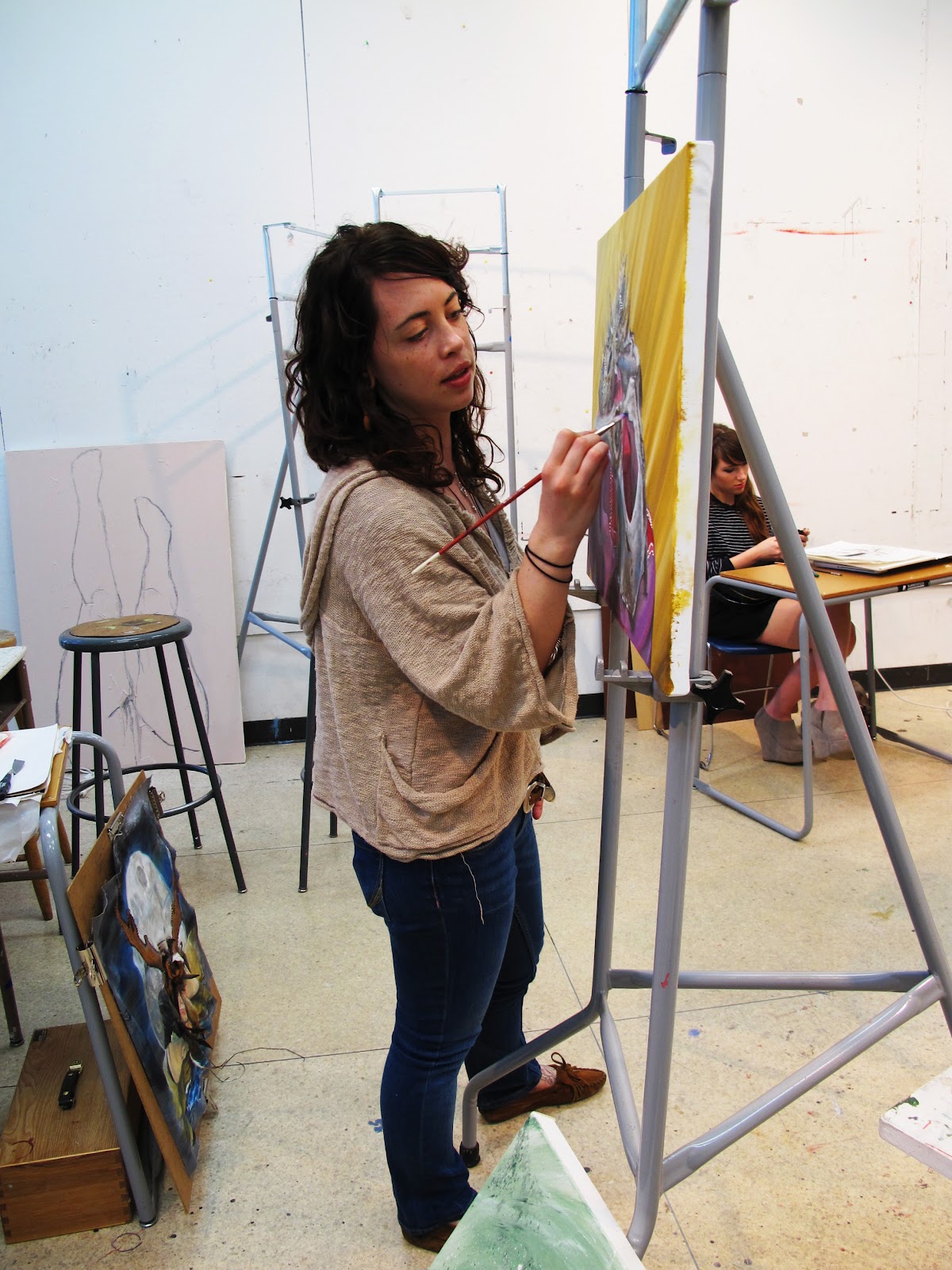
            So I rented an awesome camera for a couple days to photograph art. I have to give it back today, but I made sure to take a ton of pictures before I do. Here are some of my classmates who are awesome.


               And here is a panel from the comic Geoff and I are working on.


Wednesday, January 25, 2012

        This semester I am using my classes to really dig into my artistic process.  I have all sorts of things lined up to help me become a better artist. I am in sculpture, ceramics, and drawing. I hope that the drawing and sculpture will further define my style when drawing people.


Here is me paraphrasing a poem from 1912.  I like my version better. I might make it into a kids book.

She turned 180 degrees and described her surroundings, which were “three islands in a bay” and “three long mountains and a wood”.

She couldn’t see over her surroundings; they confined her because she felt that she could touch them; they were too close. She lost her breath.

She realized she couldn’t touch the sky like everything else around her and so she challenged the sky by looking at it for a long time until she was able to see the top and that it was not, in fact, infinite. She screamed.

The sky seemed to respond to her call. She was enveloped in feelings of eternity and vastness.

She saw the past and future and the earth open up to show her things she couldn't effect; she was punished for this.

She experienced all the sin, regret, wrong, and greed in the world as her own.

She experienced all the suffering in the world. She died with people as if she were them.  She  experienced the mourners’ sadness.

She felt people dying and had great compassion. She felt pity to them equal to the pity a god might have.

The weight this empathy brought anguished her spirit.

Freed from the weight of the world by death, but not a physical one because the Earth devoured her into a six foot grave. Her soul escaped.

She was buried and coddled in the Earth until she heard the sound of  'the pitying rain' and she liked it.

She enjoyed the sound of the rain and appreciated its presence. If she were alive she would enjoy it more. She longed to see the end of the storm when the sun comes out to shine. 
She begged god to re-incarnate her. She begged god to send the rain harder to wash the dirt from her grave.
It is not long before her prayer was answered and the rain washed her grave away.

A sweet smell came over her and she was reborn.  She was able to feel her soul again. How did she not have a soul, she wondered.

She rose out of the grave and hugged a tree.

She hugged the ground, looked to the sky, and laughed until she began to cry.  She told her new god that she would never again be unaware of its ‘radiant identity.’
Because the 'radiant identity' permeates everything on earth, she knew she could touch gods heartbeat by simply putting her finger to the earth.

Her heart and soul are vast, her inner world is massive 

Saturday, December 31, 2011

Happy New Year!

      I finished my semester with awesome grades, went to Florida with Geoff to see my brother and mother, and now I'm back in Texas.  I didn't take any pictures of our Christmas in Florida because I am on the hunt for a camera. 
      Here is some of the pottery (what hasn't been given away yet) I made under the guidance of Stan Irving from the Fall semester. I wish I had produced more, but I made enough for Christmas presents at least. I am getting better, but I still feel I have a long way to go.  I can't decide if I like pottery or painting more, so I have decided to pursue both with equal vigor.


      Here are two paintings I've been working on.  I am kind of exhausted after the semester and the trip, but have managed to jump right back into the swing of things. I am coming to a finish with The Matriarch, which I started in April.  I am not sure when a real feeling of done-ness will come with this piece. I have had such a love hate relationship with this one. At one point her face had lioness features; she has endured much transformation.  I need to plan more efficiently, because I feel like I waste a lot of time.

 The Matriarch

        This one has been in the works for a couple months.  I am in the 'hate stage' with her right now. She is just not done enough to be beautiful yet. I am hoping that in the next couple weeks we can make amends with each other.   Her shoulder and neck are still warped somehow. I have been noticing lately how much I skew reality. My perception is what needs to be overcome, or is what I battle to overcome, when I draw.
 
Angel of revenge

Tuesday, December 13, 2011

       I left off last in Aesthetics and Painting by Jason Gaiger on the third chapter called Surface and Subject. Chapter three is an introduction to how painting can be seen and analyzed.   The first couple chapters focused on what makes a painting 'good' and the traditional ideal of perfection, to duplicate reality as opposed to the more archaic Byzantine style's strict use of art for story telling. Chapter three focuses on how we actually perceive two dimensional images
         So, why bother, you ask? I know this stuff sounds crazy, but this debate has been going on since Plato so there has to be something to it, unless the philosophy of aesthetics is just a cruel joke, or a long pointless conversation with no 'conclusion' in sight, which totally could be too. The fact remains the people have such an intense desire to understand how painting works because of it's mysterious and even magical power to create illusion.
        My last mention of this book discussed the two different ways a painting can be viewed. To recap: the first way to see or describe a painting, Gaiger says, is to observe it as “a series of marks on a flat surface.” The second, he says, is to analyze it in terms of what we see, such as the emotional response it evokes, it's form,  the position of the viewer, it's depth and background, and the over-all scene being represented.
        Gaiger brings the book Art and Illusion written in 1960 by Ernst Gombrich, into the conversation. Gombrich believes that it is impossible to perceive these two forms of awareness simultaneously and that in fact our awareness shifts from seeing the painting as marks on a canvas to seeing it as the scene it is meant to represent.  Gombrich uses the well know drawing Duck-rabbit to support his theory, using it to claim that no matter how hard we try, we cannot perceive the duck and the rabbit at the same time, and that our view shifts back and forth, from duck to rabbit and back again.
         We see it the way we interpret it. He believed that this dynamic, this moment where the shift of perception changes,  offered the key to unlock some sort of mystery about reading images.On page 46 Gaiger Quotes Gombrich, "As soon as we direct our attention to the painting as a physical object that possesses its own material  reality the illusion that the artist has so carefully crafted will disappear".

 
          Gombrich also uses  writings from a man named Kenneth Clark about viewing art.  Clark talks about his experience with the painting Las Maniñas (The Maids of Honor) from 1656 by Diego Velázquez, leading artist of the Spanish Golden Age. Gombrich uses Clark's experience to validate his theory further, claiming that we cannot perceive the painting as an object and a scene at the same time and that we cannot even perceive the actual moment of the shift. Gombrich saw this as proof of the "inherent ambiguity of all images". Kenneth Clark talks about Velázquez's Las Maniñas:
One cannot look for long at Las Maniñas without wanting to find out how it was done...I would start from as far away as I could, when the illusion was complete, and come gradually nearer, until suddenly what had been a hand and a ribbon, and a peice of velvet, dissolved into a salad of brush strokes...I thought that I might learn something if I could just catch the moment at which this transformation took place, but it proved to be as elusive as the moment between waking and sleeping.


           Gaiger disputes Gombrich's view,  saying that perceiving both forms of awareness, simultaneously, are necessary to view a painting. Gaiger argues that Gombrich misidentifies Duck-Rabbit's source of visual ambiguity in that the shift that happens when observing Duck-Rabbit is not the same kind of shift that happens when we observe a painting as a series of marks verses the actual intended representation.  He goes further to say if we could perceive only one awareness at a time "we would not be able to perceive the way in which we follow the direction of a line as it is drawn across a paper, while at the same time becoming aware of the way in which that line circumscribes the outline of a shoulder or the curved back of a chair" (p52). In my opinion they are both right.