Tuesday, December 13, 2011

       I left off last in Aesthetics and Painting by Jason Gaiger on the third chapter called Surface and Subject. Chapter three is an introduction to how painting can be seen and analyzed.   The first couple chapters focused on what makes a painting 'good' and the traditional ideal of perfection, to duplicate reality as opposed to the more archaic Byzantine style's strict use of art for story telling. Chapter three focuses on how we actually perceive two dimensional images
         So, why bother, you ask? I know this stuff sounds crazy, but this debate has been going on since Plato so there has to be something to it, unless the philosophy of aesthetics is just a cruel joke, or a long pointless conversation with no 'conclusion' in sight, which totally could be too. The fact remains the people have such an intense desire to understand how painting works because of it's mysterious and even magical power to create illusion.
        My last mention of this book discussed the two different ways a painting can be viewed. To recap: the first way to see or describe a painting, Gaiger says, is to observe it as “a series of marks on a flat surface.” The second, he says, is to analyze it in terms of what we see, such as the emotional response it evokes, it's form,  the position of the viewer, it's depth and background, and the over-all scene being represented.
        Gaiger brings the book Art and Illusion written in 1960 by Ernst Gombrich, into the conversation. Gombrich believes that it is impossible to perceive these two forms of awareness simultaneously and that in fact our awareness shifts from seeing the painting as marks on a canvas to seeing it as the scene it is meant to represent.  Gombrich uses the well know drawing Duck-rabbit to support his theory, using it to claim that no matter how hard we try, we cannot perceive the duck and the rabbit at the same time, and that our view shifts back and forth, from duck to rabbit and back again.
         We see it the way we interpret it. He believed that this dynamic, this moment where the shift of perception changes,  offered the key to unlock some sort of mystery about reading images.On page 46 Gaiger Quotes Gombrich, "As soon as we direct our attention to the painting as a physical object that possesses its own material  reality the illusion that the artist has so carefully crafted will disappear".

 
          Gombrich also uses  writings from a man named Kenneth Clark about viewing art.  Clark talks about his experience with the painting Las Maniñas (The Maids of Honor) from 1656 by Diego Velázquez, leading artist of the Spanish Golden Age. Gombrich uses Clark's experience to validate his theory further, claiming that we cannot perceive the painting as an object and a scene at the same time and that we cannot even perceive the actual moment of the shift. Gombrich saw this as proof of the "inherent ambiguity of all images". Kenneth Clark talks about Velázquez's Las Maniñas:
One cannot look for long at Las Maniñas without wanting to find out how it was done...I would start from as far away as I could, when the illusion was complete, and come gradually nearer, until suddenly what had been a hand and a ribbon, and a peice of velvet, dissolved into a salad of brush strokes...I thought that I might learn something if I could just catch the moment at which this transformation took place, but it proved to be as elusive as the moment between waking and sleeping.


           Gaiger disputes Gombrich's view,  saying that perceiving both forms of awareness, simultaneously, are necessary to view a painting. Gaiger argues that Gombrich misidentifies Duck-Rabbit's source of visual ambiguity in that the shift that happens when observing Duck-Rabbit is not the same kind of shift that happens when we observe a painting as a series of marks verses the actual intended representation.  He goes further to say if we could perceive only one awareness at a time "we would not be able to perceive the way in which we follow the direction of a line as it is drawn across a paper, while at the same time becoming aware of the way in which that line circumscribes the outline of a shoulder or the curved back of a chair" (p52). In my opinion they are both right.        


Thursday, November 17, 2011


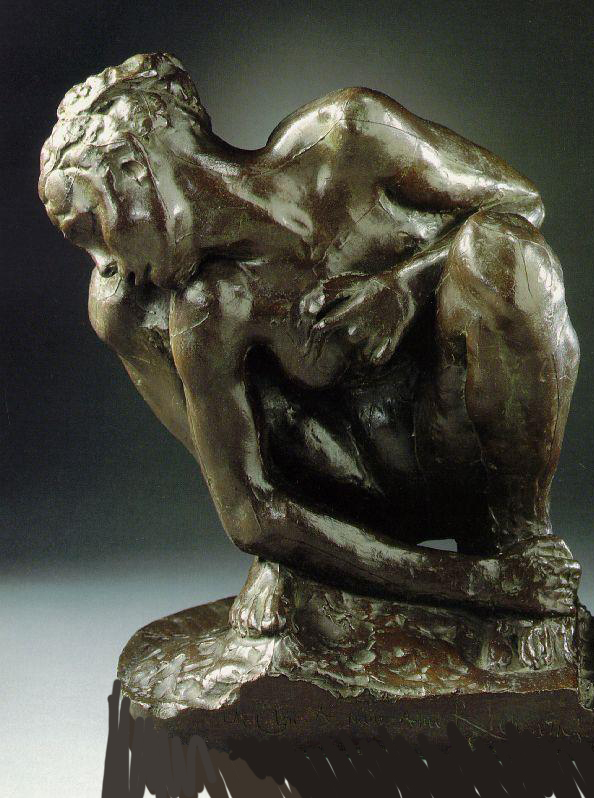
           I am working on a new mixed-media painting for my awesome Painting II class. I have learned a lot in the last three months in class, so it would be nice to go out with a bang.  In other words, I hope my painting rocks.  I have never done a mixed-media oil painting, so I am very excited.  I love acrylic gloss medium and Mod Podge; so far they have been pleasant to work with.  It dries clear, allowing for some sweet collaging. The figure in my new composition is modeled after this Rodin sculpture. I would post in-progress pictures, but it is top secret.


            Here is a still-in-progress-but-getting-closer shot of my still life. I lightened up the curtains and fixed some important subtleties.


          And an in-progress shot of my self portrait. I worked a lot on the hair and subtle facial elements. I apologize for the glare at the bottom right, my camera is difficult.


            My porch in the rain. Goodbye drought!

            The police brutality against Occupy Wall Street protests makes me sick as does the mindless, regurgitated opinions swirling around me from my media and my peers. Berkley students were beaten by police on November 9th 2011.
            Sound grenades were almost used on Zuccotti Park protestors on November 15th, but the weaponry malfunctioned. The police violence is all around us suppressing our amendment right to gather peacefully in a public space.  The protests are everywhere  One of the main regurgitated critiques I've heard from people is that Occupy is unorganized. This is confusing for me.  What part of all this don't you understand?  What part of "corporate money does not belong in politics," don't you understand? What part of "people over profit," don't you understand? People are sick of being ripped off; they have dealt with abuse after abuse for years and decades, and it's recently gotten worse with our healthcare skyrocketing, social programs dwindling, never ending wars, and then to find out that Wall Street executives have been illegally, secretively, siphoning trillions of our tax dollars away, while congress looks the other way.
         In day to day life these dynamics affect me in many ways, like when I need health care, I go either to ER or a homeless shelter. I have no hope of ever affording my own doctor, and guess what? I have student health insurance. If I can't cover the cost of what insurance doesn't, I have no other choice. There are funds for the homeless, there is insurance for the rich, but the non-existent middle class slip through the cracks. My friends who are slightly more well off then me, but by no means wealthy, are really screwed.  Most of their employee insurances cover laughable amounts of medical bills, medication, and dental, if they cover teeth at all. I have seen prescription receipts for 1,000's of dollars when I know they don't cost that much to produce. I had a friend of mine get a credit card just to get dental work.  Ha! Awful. I must owe at least thirty thousand dollars in health care bills, not to mention student loans. Our situation here in America makes me suspect the last ten years have been a plot to get us all into debtors prison where we can farm GMOs and make license plates for the rest of our lives or the fulfillment of our debts.  Is it time to leave the country?  Is it time to get a gun in case the secret police come to haul me off to debtors prison? Is it time to learn transcendental meditation so none of it matters too much? Is it time to get angry or passive? Is it time for both? My point is, I guess, that if you don't agree with Occupy, it's probably because your rich parents pay for your health insurance, or you've never had to really struggle financially, and I DON'T mean having to pawn your X-box for party money on the weekend.

Saturday, October 29, 2011

                                          I love my taste in music. Some of my favorites...


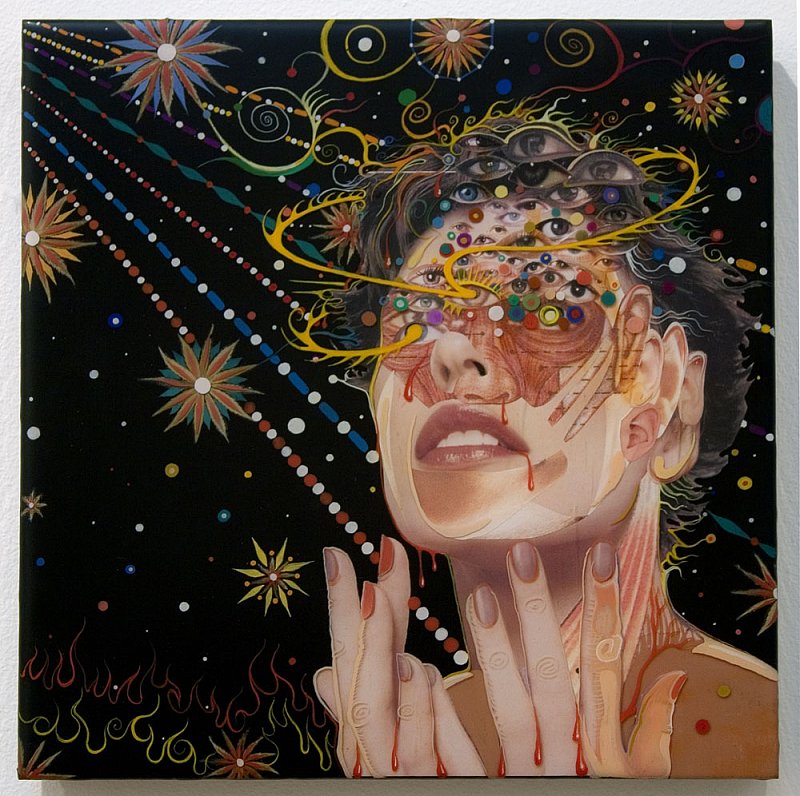
           I am working on ideas for my last painting in this awesome class. The idea is to get inspiration from a couple contemporary artists. I have chosen Jenny Saville and Fred Tomaselli to start with.

                                           Here are some images of  Tomaselli's work.


                                                         And here is Jenny Saville.


          My friend and fellow musician Tommy Alexander has finally put out a web-accessible album, which is great because I have missed playing my violin along to his songs. Just click on his name there. My top three favorites (In this order) are Sarah, Maybe One Day, and 100 Pictures, but they're all beautiful.


Sunday, October 23, 2011

   
         I am continuing to read Aesthetics and Painting by Jason Gaiger. I am on the third chapter, called Surface and Subject which begins with an introduction to how painting can be seen and analyzed.  He uses the image below to describe his ideas.  The first way to see or describe this piece, Giager says, is to observe it as “a series of marks on a flat surface.” This is accurate, but too shallow of a description, so he goes further to say that we could also analyze it in terms of what we see, such as the form of the seat supporting the woman, the white dress she wears, the metallic-gold quality of her binoculars, the position of the viewer: above and to the right, and the beige background with a simple shadow under the woman.
        Gaiger says the reason why he uses this image as an example is because it is easy to distinguish in it the difference of these two forms of perception. Here's where the philosophical thinking comes in. He says on page 39, " Both seem to be necessary to depiction. For unless you were aware that you were looking at a marked surface, you would not be aware that you were looking at a picture; and unless you were aware that the experience of looking at the picture is in some way like the experience of looking at its subject, you would not be aware of what it represents." Having made this distinction, he asks how these two ways of seeing are related to each other. "How does our visual awareness of the drawing as a physical object with a discrete set of properties enter into or inform our awareness of what it represents?"  Jeesh, Heavy stuff  : p Essentially he is asking the question of how me knowing it is a painting affects the way I see the painting. 


Adolf Menzel's Lady with Opera Glasses from 1850
        

          Giager brings a book, written in 1960 by Ernst Gombrich, called Art and Illusion, into the conversation, but more on that later.

           I am learning all sorts of techniques in this awesome painting class. It almost makes taking French bearable. Our next project is to paint the nude from life.  In the past, I have had a lot of trouble with capturing skin tones.  I tend to use too many greys, making the figures look zombie-ish. One of the most awesome tools my teacher Hollis has given me is a pallet of compatible skin tones. This knowledge is carrying over to every piece of art I am working on right now, which is a lot, by the way.
           I am researching different artists so that they might help guide me through the process. Jenny Saville (1970-) is a contemporary British painter; best known for her large-scale paintings of  women. I enjoy the skin tones she uses. They are vibrant and realistic. 


      Andrew Newell Wyeth (1917–2009) was an American realist painter. I've been studying his Helga paintings from the 80's  which are amazing. Close inspection of these pieces reveal many abstracted colors and shapes to create a very life like image. There are dots of pure cobalt and green in the skin tones when looking closely, but pulling back a step, all of these seeming abstractions form a thoughtful and alive reality.


       Here is another in-progress image of my self portrait. Photoshop has been a useful tool for comparing the reference to the painting.


Jeesh, I am still so far from being done. 


         Here is an example of how useful Photoshop is. I copy and paste certain problem areas side by side so that I can stare at them until I figure out what's wrong. Like here, the eye is shrunk down and the area on the right between the eyebrow and eye lid doesn't have enough volume as it wraps around. Geoff and I were talking about how Rembrandt would have killed for Photoshop.


           Here is an in-progress shot of my still life.  This was done mostly from life, but then I got desperate and took a picture. The bottom ellipse of the table-top is still way wrong, bur I'm on it.


       Here is me learning how to draw with my tablet. I am getting a little better. It's frustrating because my replacement tablet for the one that broke doesn't have pressure sensitivity. It's lame, but I am working around it.  When I can afford a better one, I'll be better off with the experience of drawing on a low-grade machine. It's just like learning to play on a cheap violin.   When You finally get to a well crafted instrument, you sound like a pro.


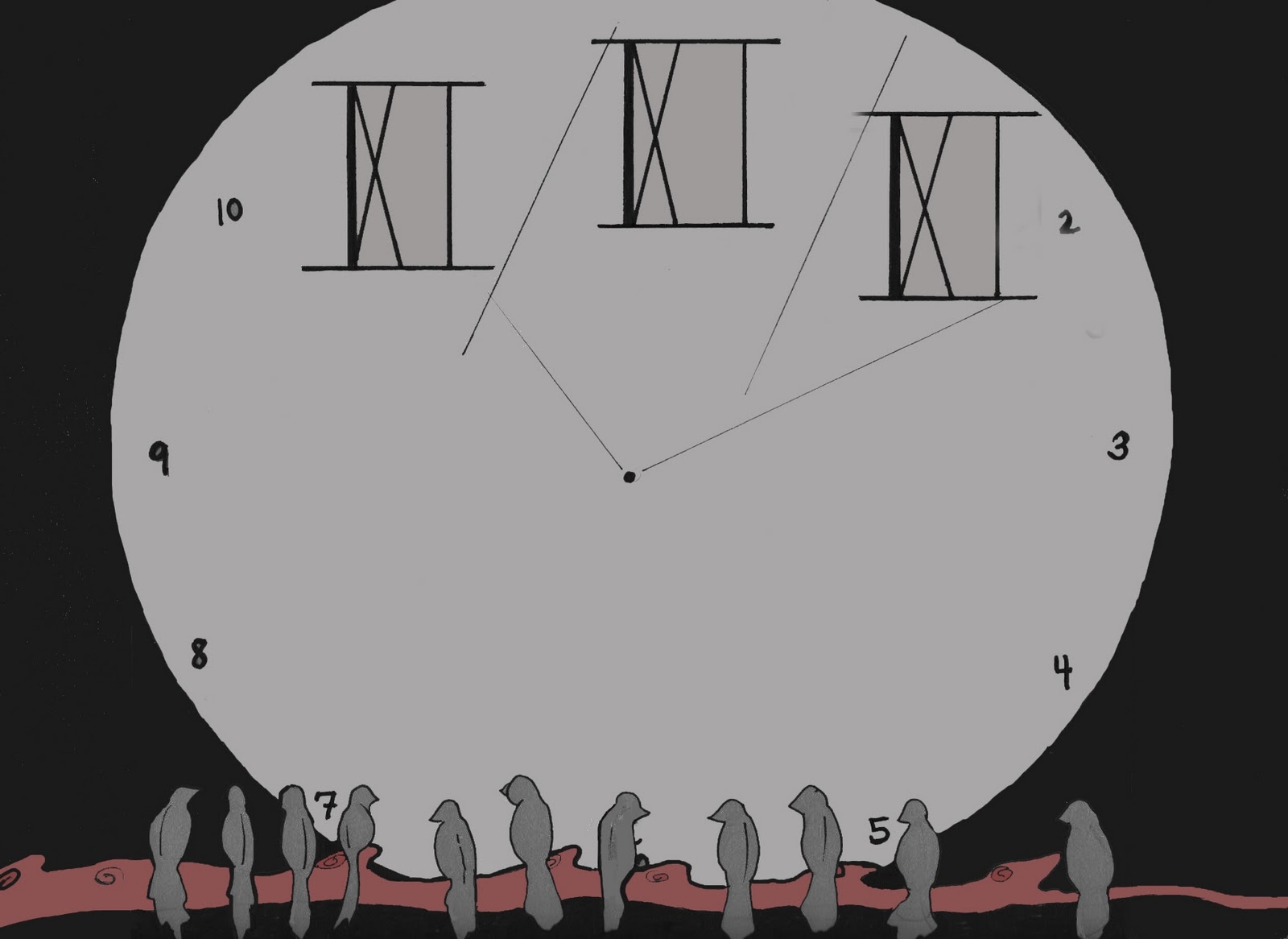
         Here is a design I made for my friend Joe Adler for his 11-11-11 album. I wish it was more animated.  My feelings wouldn't be hurt if he used it for a poster instead of the cover : )


            In other news my mother is seriously ill and it's ripping me literally in half. If any of you people who are my friends have sensed distance, this is why. I don't know what to do, but send money I don't have and hold long hours of therapy sessions with her on the phone. Her doctors are all completely incompetent due do a lack of good health care in Florida. There simple aren't the funds for the poor to get proper treatment. And I feel so inadequate to help. How shitty to have to watch my loved ones wither, while people all around me swim in wealth that they aren't grateful for. I hate that to get quality health care in America, you have to be loaded. If you are poor, you get pushed through as quickly and cheaply as possible. It makes me sick to witness this favoritism. America, you have your priorities all inside out and I am sick of it.